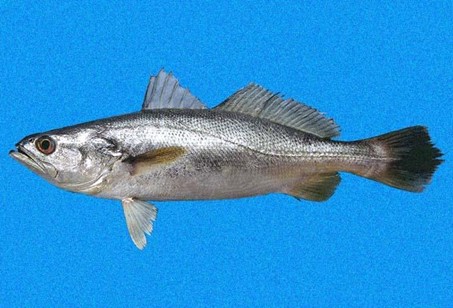


LATIN NAME Perca sp., Macquaria ambigua, Leiopotherapon unicolor
LENGTH From 2 cm to 2m (Nile Perch)
WEIGHT From a few grams to 200kg
LIFETIME Years to decades
PHYSICAL TRAITS Long rounded stature, rough scales, two dorsal fins – the first spiny and the second soft
BEHAVIOR Freshwater perch are carnivores that are most commonly found in small ponds, lakes, streams, or rivers. These fish feed on smaller fish, shellfish, or insect larvae, but can be caught with nearly any bait. They commonly spawn during the spring, when the females lay strings of eggs in covered areas such as near branches or underwater plants. During the spawning season nocturnal choruses of silver perch can be heard beginning near dusk and lasting several hours into the night. One of the largest – the Nile perch grows to 2m was introduced to Lake Victoria to develop a fishing industry. The fish has displaced and devoured many of the species of cichlids that the lake was known for.
HABITAT Both fresh and salt water species exist. Shallow waters, marine perch near coasts.
LOCATIONS Worldwide, temperate waters
FOOD Smaller fish, shellfish, or insect larvae
PREDATORS Larger fish, carnivorous mammals, humans
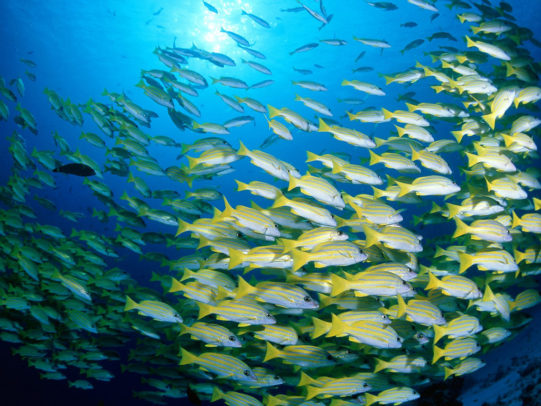
What could be more “perciforme” than an actual perch? Perch are shoaling animals and can be found in large aggregations. It is hard to determine if these chorusing perch are synchronizing their pulses, or interleaving them. The knocking characteristic indicates that sound production is probably by way of their swim bladders.
What they are conveying through the sound behavior is a bit of a mystery, but one incentive for chorusing is for the shoal to understand its extents. If a predator encroaches on the perimeter of the group their presence would cause changes in the chorusing behavior of the animals near the predator – alerting the others of the encroachment.
Another incentive might be group cohesion – akin to why humans sing songs together. Fish chorusing of this nature occurs often at dusk and dawn – a behavior that is also found in chorusing terrestrial animals like crickets and birds.
Audiographs
Sea Perch
Source: James Locascio and David Mann, University of S. Florida College of Marine Science
LITERATURE
J. Acoust. Soc. Am. 116, 3186 (2004)