

Bowhead Whale
Bowhead whales are among the Arctic’s most vocal mammals. This audiograph shows a ten-second call with shifting pitch and intensity. In dark, ice-covered seas, bowheads rely on a remarkable range of calls and complex songs to communicate, navigate, and maintain social contact.
Bowhead Whale Facts
LATIN NAME Balaena mysticetus
LENGTH Adults may reach about 19 meters (62 feet).
WEIGHT Up to about 90 metric tons (approximately 200,000 pounds).
LIFETIME Bowheads may live more than 200 years, making them the longest-lived mammals known. Traditional harpoon points and 19th-century weapon fragments recovered from whales, together with eye-lens chemistry, helped transform what scientists understood about whale longevity. Recent genetic research suggests unusually effective DNA-repair systems may contribute to their long lives.
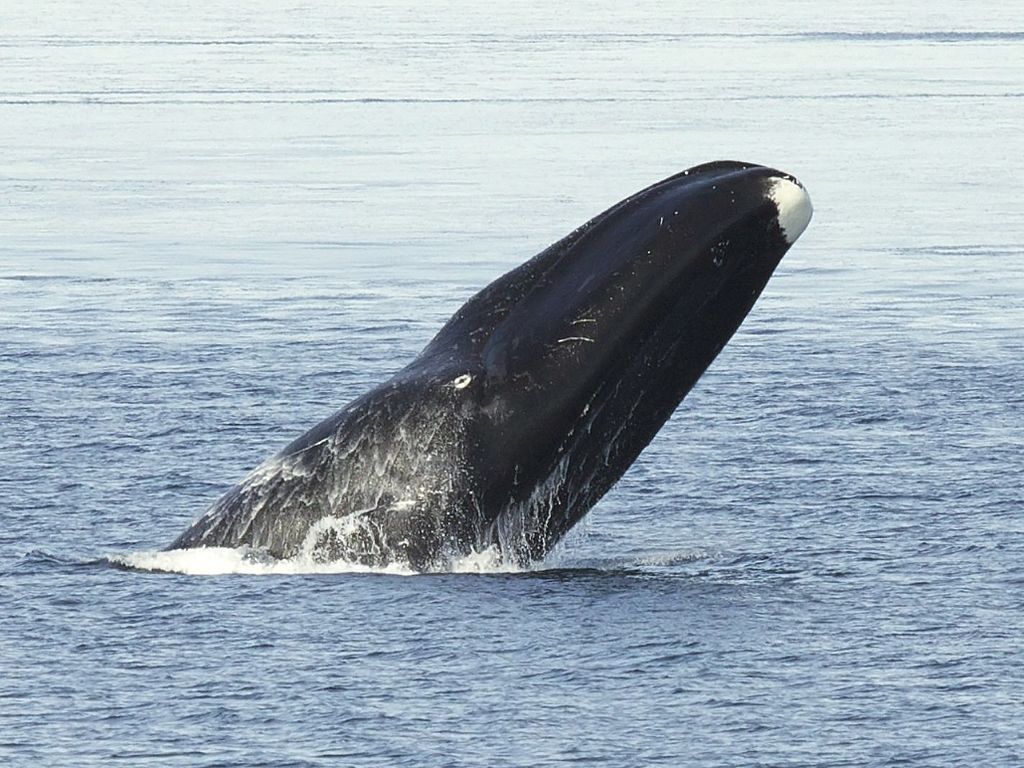
PHYSICAL TRAITS Stocky and dark-colored, with a white chin, no dorsal fin, and an enormous head that can make up roughly one-third of the body. The thick, bony skull can break breathing holes through about half a meter (20 inches) of ice.
A descriptive name given because the head suggests “bows” in several ways: the profile of the bowhead whale resembles the bow of a boat, the upper jaw is arched like an archer’s bow, and the baleen arches like a taut bow. The baleen is the longest of any whale, with plates reaching about 4 meters (13 feet) and more than 300 plates on each side of the upper jaw. Historically, whalers sought both oil and baleen for many products until synthetic materials largely replaced it—another strange industrial turn in the history of whaling.
BEHAVIOR Bowheads travel alone or in small groups, follow the advance and retreat of sea ice, and are highly vocal. Their repertoire includes low-frequency calls, pulsed sounds, and elaborate songs. They can produce two harmonically unrelated tones at once. Acoustic monitoring off Svalbard documented 184 song types across three winters; newer fine-scale work shows that some patterns persist for weeks while others can change within minutes.
HABITAT Almost exclusively Arctic and subarctic waters, especially along seasonal sea-ice edges. Bowheads are often seen near belugas as both species move through leads in the ice.
LOCATIONS Arctic waters of Alaska, Canada, Greenland, Russia, and the Svalbard–Barents Sea region, including the Bering, Chukchi, Beaufort, Okhotsk, and northern Atlantic seas.
FOOD Small crustaceans—especially copepods and euphausiids (krill), as well as amphipods and mysids—filtered from the water through the baleen.
PREDATORS Killer whales are the primary natural predator. Human-related threats include climate-driven changes in sea ice, entanglement in fishing gear, vessel strikes, contaminants, industrial activity, and ocean noise.
Bowhead whales have sustained Indigenous Arctic communities for millennia and remain nutritionally, culturally, and spiritually important. Alaska Native communities co-manage the subsistence harvest, and traditional knowledge continues to make essential contributions to bowhead research and conservation.