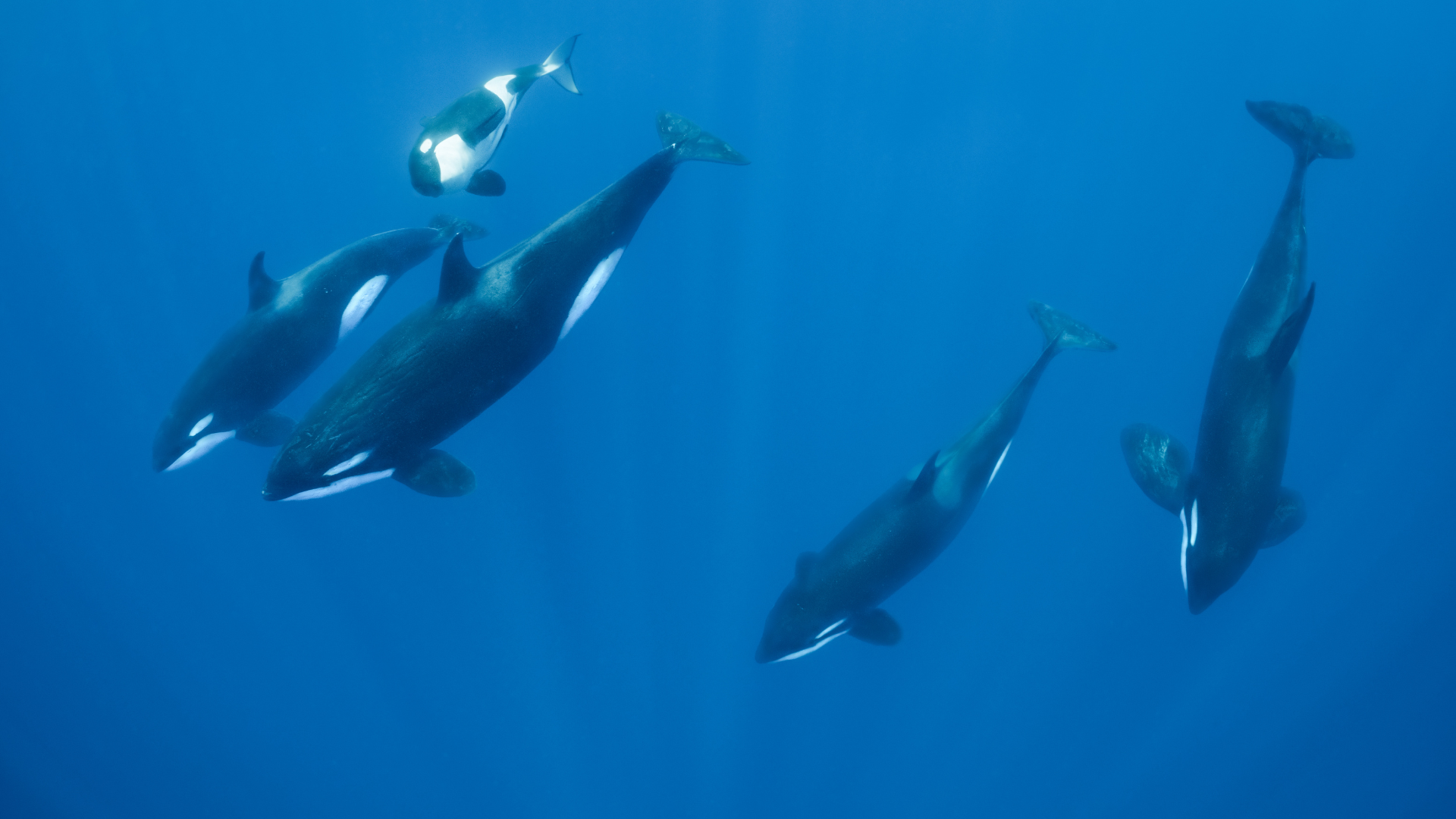


Pilot Whale
Pilot Whale Calls — Recording 1
Pilot Whale Calls — Recording 2
Pilot whales are among the largest members of the dolphin family, after orcas. Echolocation clicks aid them in their search for food. Whistles and burst pulses allow them to maintain contact with their pod members. Their vocal behavior changes with their activities. Listen for yourself in these two audiographs.
Pilot Whale Facts

LATIN NAME Globicephala melas (long-finned pilot whale) and Globicephala macrorhynchus (short-finned pilot whale).
LENGTH Long-finned pilot whales can reach about 5.8–7.6 m (19–25 ft). Short-finned adults range approximately 3.7–7.3 m (12–24 ft). Males are larger than females.
WEIGHT Long-finned adults weigh roughly 1,300–2,300 kg (2,900–5,000 lb); short-finned adults roughly 1,000–3,000 kg (2,200–6,600 lb), with variation by sex and population.
LIFETIME Roughly 35–60 years; females generally live longer than males.
PHYSICAL TRAITS Pilot whales are mostly dark gray, brown, or black, but have some light areas such as a gray saddle patch behind the dorsal fin. Long-finned and short-finned pilot whales are so similar, it is difficult to tell the two species apart. They were traditionally differentiated by the length of the pectoral flippers relative to total body length and the number of teeth.
BEHAVIOR Pilot whales emit echolocation clicks for foraging and whistles and burst pulses as social signals, for example to keep contact with members of their pod. Their vocal behavior varies with activity, and differences have been found in the calls of the two species. Pilot whales have strong group fidelity, which may contribute to their occasional mass strandings. The causes of any particular stranding can be complex; following a sick or wounded group member is one proposed explanation, rather than an established explanation for all strandings.
HABITAT The long-finned pilot whale prefers cooler waters than the short-finned species, with populations in the North Atlantic and Southern Hemisphere. Pilot whales can be found in oceans nearly worldwide. Long-finned pilot whales can dive to depths of about 2,000 feet for 10 to 16 minutes.
LOCATIONS Depending on the species, their range includes waters around Chile, Argentina, South Africa, Australia, New Zealand, the United States, the Azores, Morocco, Greenland, Iceland, northern Norway, and the Mediterranean. Short-finned pilot whales generally inhabit tropical and warm temperate waters; long-finned pilot whales favor colder temperate and subpolar waters.
FOOD Short-finned pilot whales feed mainly on squid, but they may also feed on octopus and fish. Long-finned pilot whales feed on fish (e.g., cod, dogfish, hake, herring, mackerel and turbot), cephalopods (e.g., squid and octopus) and crustaceans (e.g., shrimp). Much long-finned pilot whale feeding occurs at night in deep water between depths of 650 and 1,650 feet.
PREDATORS & THREATS Pilot whales, given their large size, face few natural predators. Interactions with orcas can be complex and are not yet fully understood. Human-related threats include hunting in parts of their range, fisheries bycatch, pollution, vessel strikes, and underwater noise.
Sources & further reading
NOAA Fisheries: Long-finned pilot whale
NOAA Fisheries: Short-finned pilot whale