
Cuvier’s Beaked Whale
The Cuvier’s beaked whale holds the record for the deepest plunge by a marine mammal. The deepest recorded dive reached 9,816 feet (2,992 m), and the longest documented dive lasted 222 minutes—descending roughly the length of eight Empire State Buildings. Like other toothed whales, Cuvier’s beaked whales use echolocation for navigation and foraging. They produce a series of clicks, which are high-frequency sound pulses.
Description
Overview
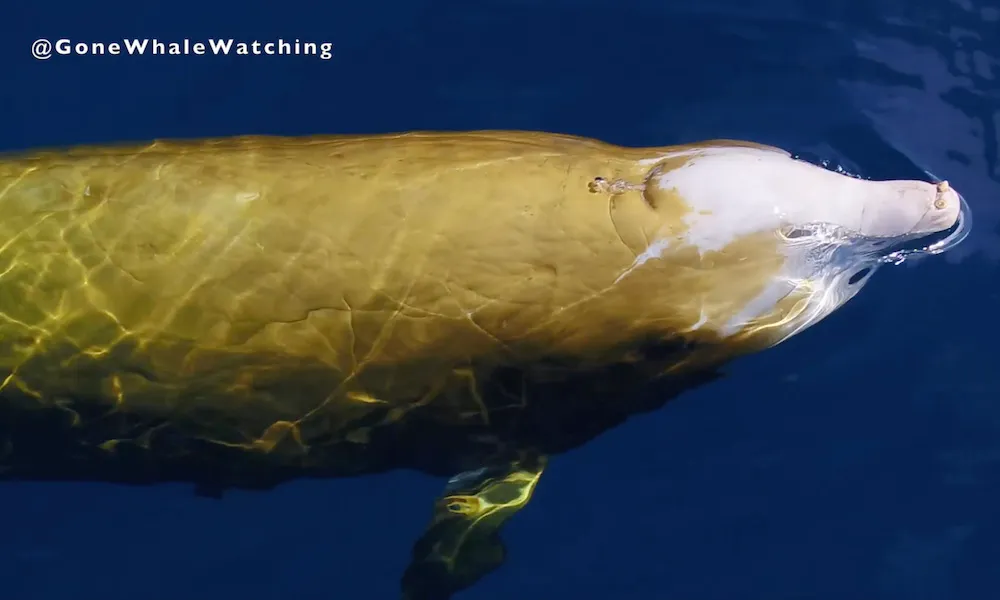 Ziphius cavirostris, or Cuvier’s beaked whales are the most ubiquitous of the beaked whales, found worldwide in deep waters outside the high polar regions. Adults are generally 6–7 m (19–22 ft) long and weigh 1,800–2,700 kg (2.5–3 tons), although individuals outside this range have been documented. One specimen was estimated to have died at 62 years; NOAA summarizes the species’ lifespan as up to about 60 years.
The recordings are stereotypical hunting clicks—the single clicks might be likened to a “blinking flashlight” seeking prey. Once the prey is located, they “keep the light on,” creating a rapid buzz as the flashes get shorter—matching the sound-travel distance to the prey as they move in for the catch. This is a common acoustical characteristic of many echolocating odontocetes.
Identification & Deep-Ocean Habitat
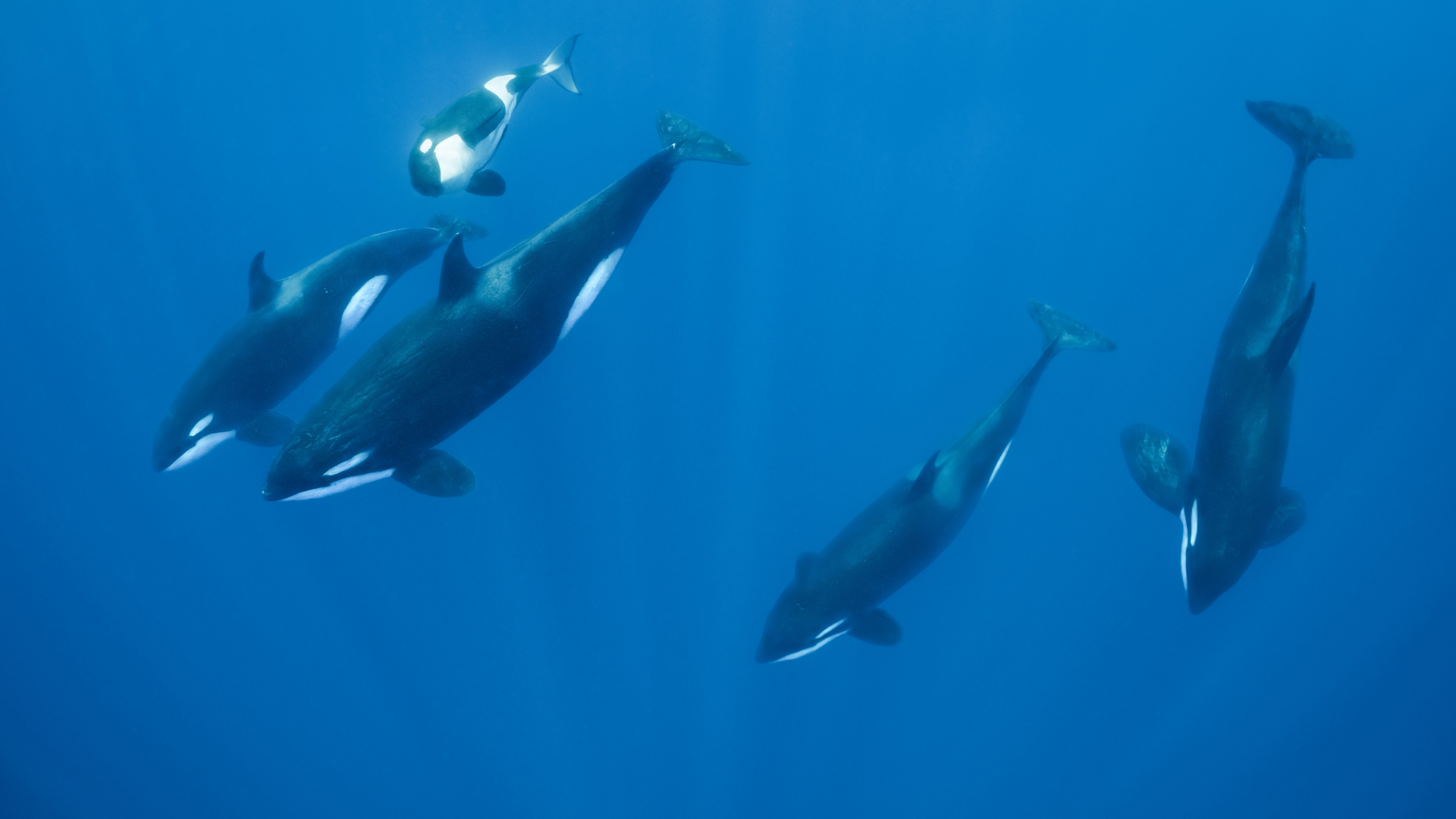
Males develop two tusk-like, cone-shaped teeth in the right and left corners near the tip of their lower jaw. The females have these same teeth, but they usually remain unerupted. Older animals often show a paler head and linear scars. Their food is primarily squid, along with fish and crustaceans. Probable predators include orcas and larger sharks.
How Cuvier’s Beaked Whales Use Sound
The first recording captures the rapid buzz heard once the prey is located; the second presents the single clicks used while seeking prey. These clicks are emitted in a narrow, forward-directed beam and are reflected back to the whale by objects in the environment, providing information about the location and nature of the object. The flashes get shorter as the whale closes the sound-travel distance, changing from separated search clicks to the terminal buzz used as it moves in for the catch.
Beaked whales are a very deep-diving group, foraging as deep as 3,000 m (nearly 10,000 ft). At this depth they are subject to roughly 300 atmospheres of pressure. Under these pressures, their lungs and other air spaces collapse as they descend—one of several adaptations that allow them to spend long periods at depth while limiting nitrogen absorption.
Record-Setting Dives & Sonar Sensitivity
The deepest and longest documented dives reveal extraordinary adaptations for oxygen storage, pressure tolerance, and long periods without breathing. Most dives are shorter, but Cuvier’s beaked whales routinely forage in deep waters under great pressure, where there is no light and sound is their most effective way to find prey.
Scientists explored the pathology of Navy sonar-associated beaked whale strandings in Grand Abaco, Bahamas, in 2000 and the Canary Islands in 2002. Necropsies from the Canary Islands revealed gas and fat emboli and other lesions consistent with a decompression-like syndrome. It took a few years of informed debate to understand that the whales had been foraging in deep waters, under great pressure. The evidence does not show that sonar simply deafened the whales or that, being panicked, they immediately headed to the surface. The best-supported understanding is that mid-frequency sonar can disrupt their typical diving and foraging behaviors, potentially contributing to harmful gas-bubble formation—an injury sometimes compared to “the bends” that divers can experience after too rapid a decompression. Scientists continue to study the precise chain of events.