

Gray Whale
Their vocal repertoire consists of knocks, croaks, bangs, and grunts. Not sounds that humans find compelling, but probably pretty important to the Grays. This ten-second audiograph shows a gray whale recording, with changes in sound visible in the waveform and spectrogram.
Gray Whale Facts
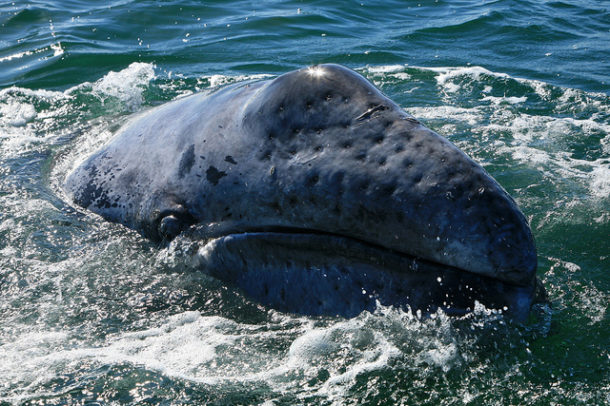
LATIN NAME Eschrichtius robustus (also called “devil fish” and “mud whale”).
LENGTH Adults are generally about 13–15 m (42–49 ft); females are slightly larger than males.
WEIGHT Up to about 41 metric tonnes (90,000 pounds).
LIFETIME Average and maximum lifespan are not well established. One female was estimated to be 75–80 years old when she died.
PHYSICAL TRAITS Dark slate-gray in color and covered by characteristic gray-white patterns and scars left by parasites. They have short baleen, a dorsal hump followed by 6 to 12 “knuckles,” and no dorsal fin. The body usually has patches of barnacles and whale lice—small crustaceans, not mites.
BEHAVIOR Gray whales eat by turning on their sides and pulling crustaceans and other invertebrates out of the mud and sand on the shallow sea bottom. They migrate along the coasts, breeding and giving birth in lagoons and coastal waters in the southern extents of their migrations. Gestation lasts about 12–13 months.
Their vocal repertoire consists of knocks, croaks, bangs, and grunts. Not sounds that humans find compelling, but probably pretty important to the Grays.
HABITAT Coastal waters, often above the continental shelf. Although they usually travel near shore, some cross deep offshore waters during migration. Established populations now occur in the North Pacific; the former North Atlantic population disappeared centuries ago.
LOCATIONS Eastern North Pacific gray whales winter along the coast of California and Mexico, breeding and giving birth especially in the lagoons of Baja California. Many migrate north to feeding grounds in the Bering and Chukchi seas; others feed farther south along the Pacific coast. Western North Pacific gray whales feed off Sakhalin Island and Kamchatka, Russia. Some whales using these western feeding areas also migrate across the Pacific.
FOOD Crustaceans and other invertebrates, especially amphipods, often found buried in mud and sand. Old whalers called them “mud whales” because they forage for invertebrates buried in the mud. They filter out the food with their short, bristly baleen that is reminiscent of a deck brush.
PREDATORS Orcas. Human-related threats include entanglement in fishing gear, ship strikes, habitat disturbance, and ocean noise. Changes in food availability and ocean conditions also affect their survival.
Whaling and changing populations
They were also called “Devil Fish” because they aggressively defended themselves when attacked by whalers. Commercial whaling drove both Pacific populations close to extinction before international protection measures were introduced in the 1930s and 1940s.
The Western Pacific Grays remain endangered and face oil and gas activity near their summer feeding grounds. NOAA describes fewer than 300 western gray whales based on photo-identification work. The Eastern Pacific population can no longer simply be described as “pretty healthy.” It has experienced a major decline since its 2016 peak, and calf production has remained low since 2019. Recent abundance estimates fluctuate, so a higher survey estimate alone does not establish recovery.
In May 2010 a gray whale was sighted in the Mediterranean off Israel and later off Spain. Whether an intrepid scout or a wandering individual, its exact origin was not established. Researchers considered an eastern Pacific whale traveling through the Arctic a likely explanation.
Further reading & original literature
NOAA: Gray whale biology and threats
NOAA: Latest population monitoring
Scheinin et al. (2011): Mediterranean sighting
Crane, N.L. and Lashkari, K. 1996. Sound production of gray whales, Eschrichtius robustus, along their migration route: A new approach to signal analysis. Journal of the Acoustical Society of America 100(3): 1878–1886.
Cummings, W.C., Thompson, P.O. and Cook, R. 1968. Underwater sounds of migrating gray whales, Eschrichtius glaucus (Cope). Journal of the Acoustical Society of America 44(5): 1278–1281.
Richardson, W.J., Green, C.R. Jr., Malme, C.I. and Thomson, D.H. 1995. Marine Mammals and Noise. San Diego, CA: Academic Press.
Wisdom, S., Bowles, A.E. and Anderson, K.E. 2001. Development of behavior and sound repertoire of a rehabilitating gray whale calf. Aquatic Mammals 27(3): 239–255.